 Find Romantasy Books
The Library of Amorlin: Deluxe Limited Edition (The Age of Beasts)
Kalyn Josephson
4.4
by Mark Lawrence
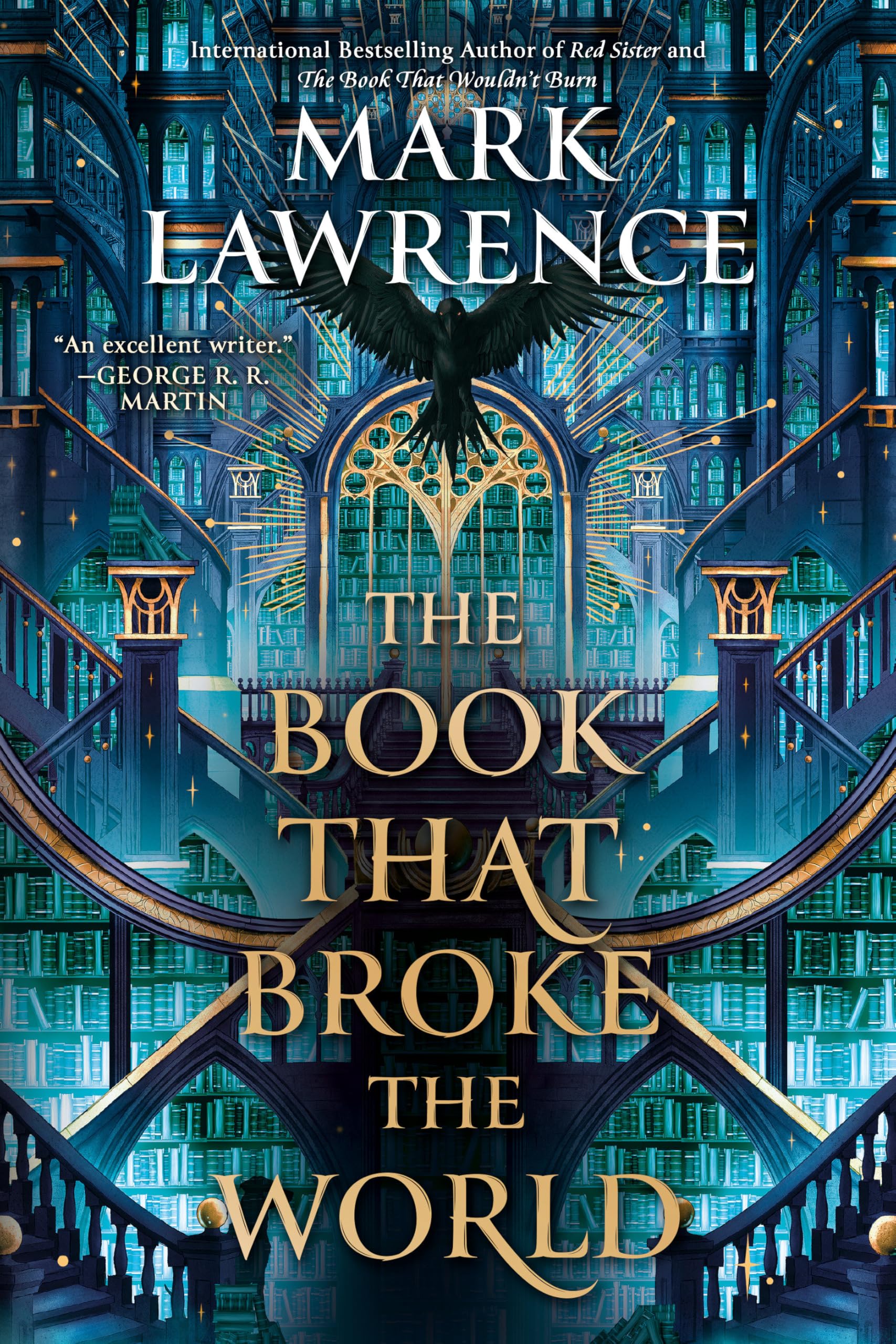
The Library is a cosmic tapestry weaving together distant worlds, infinite timelines, and the collective memories of civilization. Within its shifting halls, the bond between Evar Eventari and Livira Page faces its ultimate test as a shadow war threatens to unravel reality itself. Separated by the Library’s vast, uncaring architecture, the two protagonists find themselves propelled toward divergent, perilous destinies.
Evar, forced into exile, must navigate the harsh, unfamiliar terrain of a world outside the Library’s walls while fleeing an implacable enemy. Meanwhile, Livira remains trapped within the haunting confines of a ghost world. To escape and reunite with Evar, she must confront the very stories she has authored, navigating the surreal landscapes of her own creation to reclaim a forbidden volume—a book that holds the singular power to dismantle the Library entirely.
As ethereal forces manipulate them like pieces in a high-stakes game, Evar and Livira must reconcile their identities with their legacies. Their connection serves as the heart of a conflict that transcends space and time. With the future of existence hanging in the balance, they must decide what is worth destroying and what is worth saving in a world where history is never truly settled.
KimberlyMAn exciting cliffhanger!
"LOVED this second installment of the trilogy! Livira's ghost essence is forced to flee her Assistant body when it is killed by skeer and she follows Evar as he flees the library. Yute's daughter confronts her and instructs her to find the book she wrote, explaining that the only way to save the world is to find the book. We're introduced to a new species, called the ganar. Hellet and Celcha are brother and sister ganars. The ganars have been enslaved by humans and caniths. Evar's "missing" brothers manipulate them in a plot to destroy the world. Evar’s journey takes him beyond the library into an unfamiliar world, while Livira dives into her own writing, confronting her stories head-on to reclaim the book. The book explores the idea that humans have a knack for taking rule-based systems and using them in ways the creators never intended. At its core, one of the main tenets of this trilogy is time travel, so there is quite a bit of that in this second installment. Time travel is tricky but the author has done an excellent job of making the events plausible in relation to the time shifts. I thought that the portion where Livira has to live the stories she wrote kind of silly feeling. That was supposed to create a deeper connection between her and her book, making it easier for her to physically find, but that premise just seemed a little implausible. Other than that, I found it an exciting read and I'm looking forward to the third book. ["
January 28, 2025 Verified Purchase
AmancerGood read. Continues story. Much shorter.
"Not as good as the first book but how many sequels are? It is about half the volume of words of the first one. I like phat books. ["
March 29, 2025 Verified Purchase
CarolinaA Gripping Continuation That Leaves You Eager for More
"After reading "The Book That Wouldn't Burn," I was hungry for more. Even though the first book was long, I loved every second and felt sad when I had so little left. The second book, though shorter, did not disappoint. It masterfully introduces new characters and gives us glimpses of Livira and Evar while setting the stage for something grander yet to come. The book delves into themes of knowledge, power, and the consequences of secrets. It challenges readers to think about truth and the cost of wisdom while delivering an action-packed and emotionally resonant story. I loved every moment. Even though it felt shorter, it packed a punch and left me eagerly anticipating the next installment. The pacing was perfect, and the setup for the future is tantalizing. I can't believe we're only getting a trilogy—I'm obsessed. It's been so long since a book has made me feel excited, sad, anxious, giddy, relieved, and all those rollercoaster emotions. I even got the audiobook on top of the ebook and physical copies because I couldn't stop until I knew what was going to happen! I highly recommend this book to fans of high fantasy who appreciate detailed world-building and complex characters. If you loved the first book, you won't be disappointed by this continuation. It's a must-read for an immersive and thought-provoking fantasy series. ["
July 19, 2024 Verified Purchase
JBForm over Function
"Mark Lawrence refers several times to the Ouroboros, the snake that eats its own tail. I think for a reader to appreciate this story, there's a requirement to release oneself from the conventions of linear story telling. There have been complaints about the tendency of this work to repeat itself, often with subsequent chapters revisiting the same scenes from different character points of views, making the pacing a bit sluggish. My favourite part of these stories continues to be the epigraphs. I feel that this is where the writer is relaxed, willing to laugh at himself and break the fourth wall while keeping the "library" theme of the books going. In this trilogy, I get the impression that Mark Lawrence is pushing himself to write a book without the safety harness of plot and linear timeline. This makes the plot more like the ouroboros, I believe the entire plot has actually already been presented to us, all the characters introduced, and it is only in the telling and retelling, in this somewhat spiral, that everything gets revealed in various facets. On an intellectual level, I admire this. This is a writer, trying something bold. On another level, I wonder if Mark Lawrence isn't inadvertently writing himself into a hole. If this is his strategy, it may have been better achieved in a single novel, instead of trying to make a trilogy. On character who seems to suffer from this is Livira. I think that this is a character that the author created, loved, and then didn't know what to do with. This seems to result in very little Livira in the second book, with her becoming some sort of ideology instead of a person. The main characters now become other people who had interacted with Livira, been affected deeply by her, and then sort of just wandering around trying to either find her, save her or destroy her. This second book introduces a totally new race, which was hinted at, but never named in the first book. This gives us a new character in the form of Celcha, a ganar slave who is rescued from the dust by discovery of books, and together with her brother ends up in the library. While there she makes friends with a human librarian named Lutna, who gives off vague Livira 2.0 vibes. Given the "reveal" of this volume came from the angles being characters we already met, and with similar names, I am suspecting that Book 3 may give us a Lutna/Livira "reveal" Another way this book suffers from this circular story telling is with the villains. I think a good villain makes for great story telling, but Mark Lawrence seems to struggle with presenting a convincing "big bad". Apart from the mythological warring brothers, the roles of antagonist in this book is also played: by the King from book one; the skeer hive-mind; the anger of the ganar; whatever Yute is going through... These just seem to exist to cartoonishly create problems for the main characters, but the fact that these problems rarely last long and characters are frequently saved by ridiculous deux ex machina moments makes it difficult to take seriously. Rules the narrative creates and suspended, broken and ignored for the main characters. Well, no, not really, one main character is sacrificed I guess to make the story "real", but by the time that happens, what was one of my favourite characters in book 1 has been reduced to a caricature of themselves in book 1. On a final note… the interspecies “situationships….””. I’m working to suspend belief here and trying to be like, “it’s like donkey and dragon in Shrek, the how doesn’t matter, it’s just about the connection”, but the writer also seems to be a little too focused on the physicality of the characters for me to not be a bit horrified by the concept. What are the rules in this world building? Can a ganar fall in love with a skeer? Or are we meant to see this less as a species difference and more as a race difference? By the end of this, will it really just be Aprix and Clovis making trips to Whole Foods, trying to decide whether it is ganar for dinner and what they’ll watch on Netflix? All this said, I'm definitely waiting for the final instalment, just because I'm really curious about what the author will do next. I think the form is intriguing, and with some finesse, this series could really break new ground in the art of storytelling. I only hope that in the desire to break new ground in literature, the writer does not sacrifice the essence of good storytelling. 3/5 ["
May 10, 2024 Verified Purchase